
Architecture
Zene is a high-performance, embeddable agent execution engine designed for precision, speed, and control. Its architecture is divided into clear layers, from the high-level host interaction down to the low-level infrastructure.
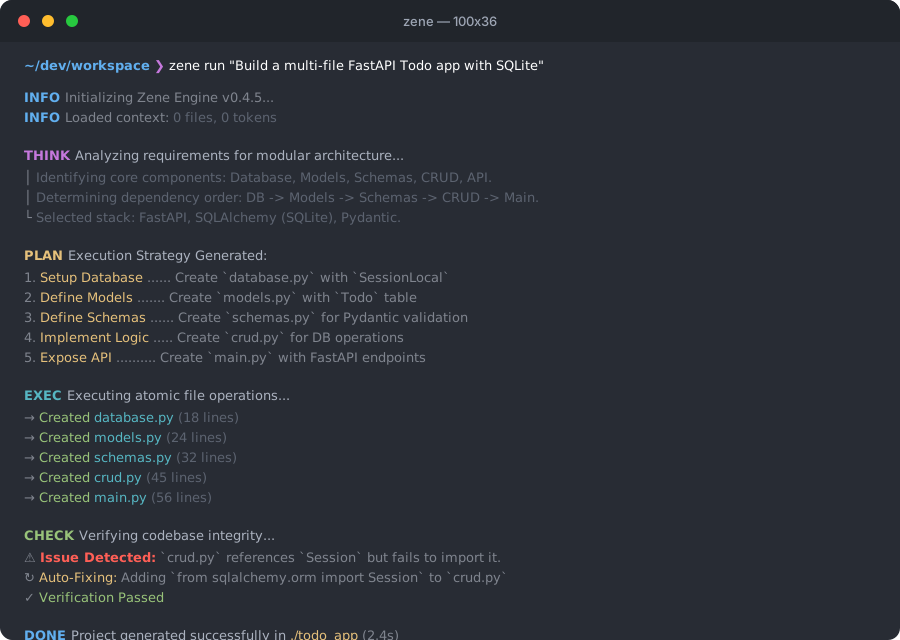
1. Core Philosophy
- Embeddable Runtime: Zene should work in-process or behind a thin worker process.
- Asynchronous & Concurrent: Built on
tokiofor massive parallelism in tool execution. - Session Isolation: Environment and history are scoped to individual runs and sessions.
2. Agent Workflow (OODA Loop)
Zene follows an Observe-Orient-Decide-Act loop to solve tasks.
graph TD
    User --> O1[Observe: Context Retrieval]
    O1 --> O2[Orient: Code Analysis]
    O2 --> D[Decide: Planning/CoT]
    D --> A[Act: Tool Execution]
    A --> V[Verify: Test/Result]
    V -- Fail --> D
    V -- Pass --> Result
The Steps:
- Observe: Analyze the project structure and semantically retrieve relevant code (RAG).
- Orient: Use
tree-sitterto build a mental map of definitions and dependencies. - Decide: Formulate an atomic plan using Plan-Execute-Reflect (P3).
- Act: Execute tools (Edit, Shell, Python) in isolated child processes.
- Verify: Self-correct by checking compiler output and running tests.
3. Technical Architecture
Module Structure
src/agent/: Strategy-facing coordination, LLM interactions, planning, reflection, and execution loops.src/engine/: Runtime contracts, run lifecycle, context management, session storage, and tool implementation.src/main.rs: Thin host-facing CLI entrypoints, including one-shot CLI and worker mode.
Runtime Lifecycle
Zene now models one execution as a tracked run with explicit runtime state.
RunRequest: Host input, including prompt, session id, environment, and optional strategy.RunHandle: Host-visible handle returned bysubmitfor streaming and later inspection.RunSnapshot: Snapshot of run status, timestamps, output, and terminal error state.RunStatus:Pending,Running,WaitingTool,WaitingApproval,Completed,Failed, orCancelled.
This gives hosts a stable execution contract regardless of whether they embed Zene directly or run it behind a worker process.
Strategy Boundary
Zene currently exposes explicit execution strategies:
Planned: Create or reuse a plan, then execute and reflect over planned tasks.Direct: Skip planning and execute the request as a direct task.
The important boundary is:
- strategy objects decide flow
- the orchestrator exposes reusable execution helpers
- the executor and tool manager perform the actual work
Concurrency & Isolation
Zene avoids global state. All mutable data (environment variables, session history) is wrapped in Arc<Mutex<Session>>.
- Environment Management: Variables are injected only at the child process level, preventing "Environment Pollution" in the main server.
- Safe Parallelism: Independent tools are executed concurrently using
join_all.
4. Operational Modes
- One-Shot CLI: Transient execution for quick terminal tasks.
- Worker Process: Spawn-per-request JSON input and JSONL event output for host integrations.
- Embedded Runtime: Direct host calls through
ZeneEngine, including streaming, run tracking, and cooperative cancellation.
5. Observability (xtrace)
Automated tracing is baked into the architecture:
- Trace ID Propagation:
X-Trace-Idheaders andZENE_TRACE_IDenvironment variables link all tool activity back to the original task trace. - Automated Metrics: Token usage and span durations are captured per session without manual boilerplate.
6. Kernel Boundary
As Zene evolves, the architecture should treat orchestration patterns as replaceable strategies rather than as engine truths.
- Execution Kernel: Owns runtime state, tool calls, events, persistence, and failure semantics.
- Decision Strategy: Owns plan-first, direct execution, routing, evaluator loops, and other orchestration choices.
- Product Policy: Chooses which strategy to use for a given surface or workload.
The current refactor direction is already visible in the codebase:
- the runtime owns run lifecycle and cancellation
- worker mode is a thin transport around the runtime
- strategies choose between planned and direct execution
- orchestrator methods are being reduced to reusable execution helpers
For a deeper design note, see Execution Kernel vs Strategy.